ML Fundamentals
Data on its own only tells you what already happened. A model is how you get something you did not already know from a table. This page covers what a machine learning model is, how you train and test one, and the main families of models you will meet.
Data science, machine learning, and AI
Three words that get used interchangeably and are not the same thing:
- Data science is the broad field of studying data and pulling insight and information out of it, in whatever form it arrives.
- Machine learning is the study of algorithms and statistical models that predict something or take an action without being given explicit instructions for how to do it.
- AI is the bigger umbrella: an agent that acts on its environment based on what it observes, often using machine learning to do so.
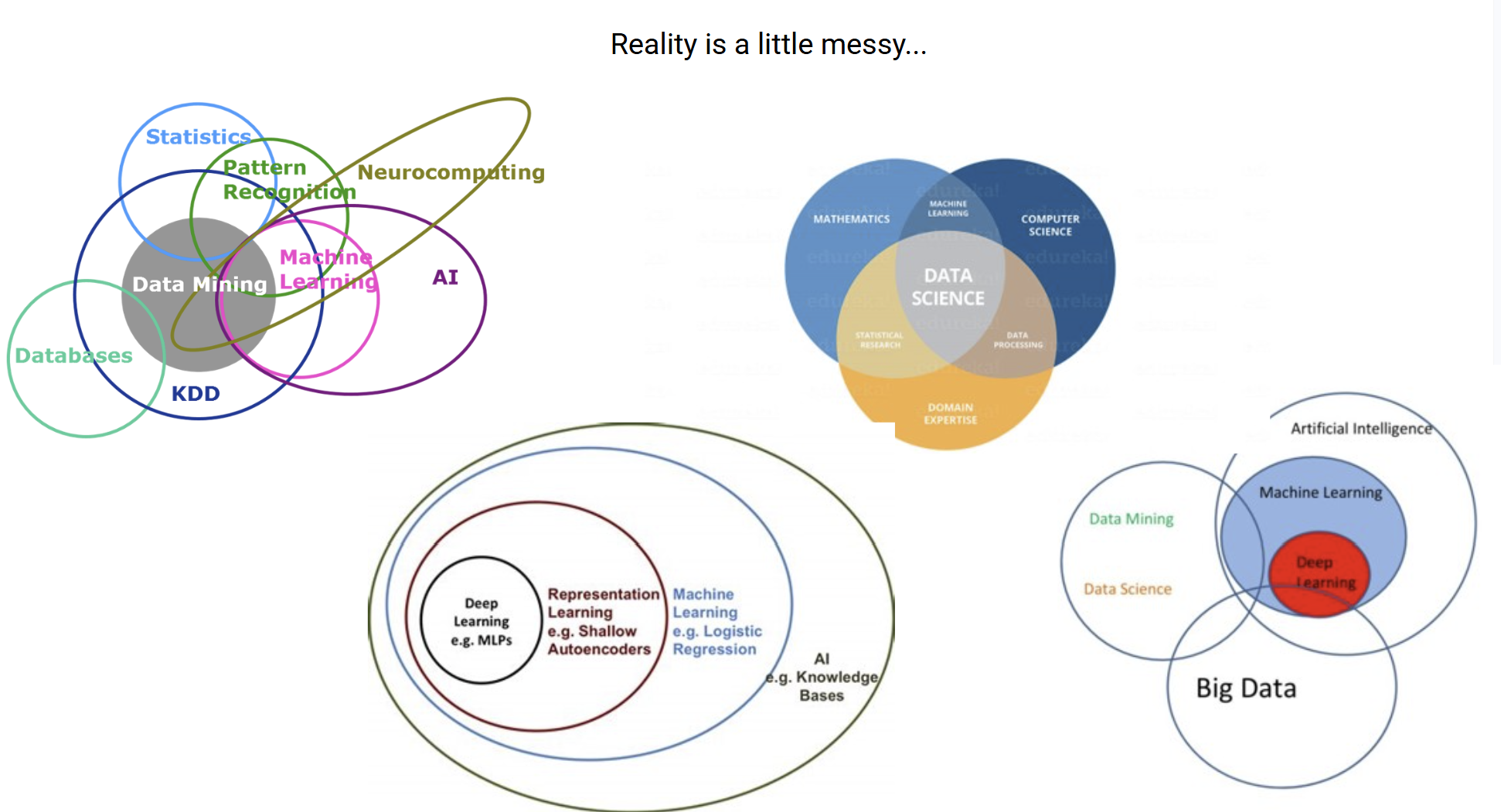
The boundaries are fuzzy and depend on whose Venn diagram you are reading. Deep learning, big data, and databases all get layered in as well. For learning purposes, the three definitions above are enough.
When do you need machine learning?
You need it when you cannot write the rules yourself.
Some problems are easy to model directly. Did you pass the test? You scored a 7, the pass mark is 6, so yes. No machine learning required.
Now predict whether you will pass a test tomorrow. The test has not happened, so the answer does not exist yet. What you do have is other information: hours studied, results on previous tests in the subject, how well the material suits you. You want a prediction from indirect signals, without anyone handing you the formula. That is machine learning.
A useful warning built into that example: the prediction can change the outcome. Predict a pass, study less because of it, and fail. Models sit inside the world they are predicting.
The two ingredients
Data, covered on the previous node, and a goal.
You cannot build a model that solves everything, that would be closer to general AI. You build a model for a specific question, called your hypothesis: "will this house sell", or "what will this house sell for". Some questions can be answered with the data you have and some cannot, and learning to tell the difference is most of the skill.
Training, testing, and new data
Take the classic example: predicting house prices. You start with houses that have already sold, with features like number of bedrooms, floors, size, and age, plus the price each one fetched.
Here is the problem. If you train on all of them and then predict a price, you have no way of knowing whether the prediction is any good. So you cheat, on purpose:
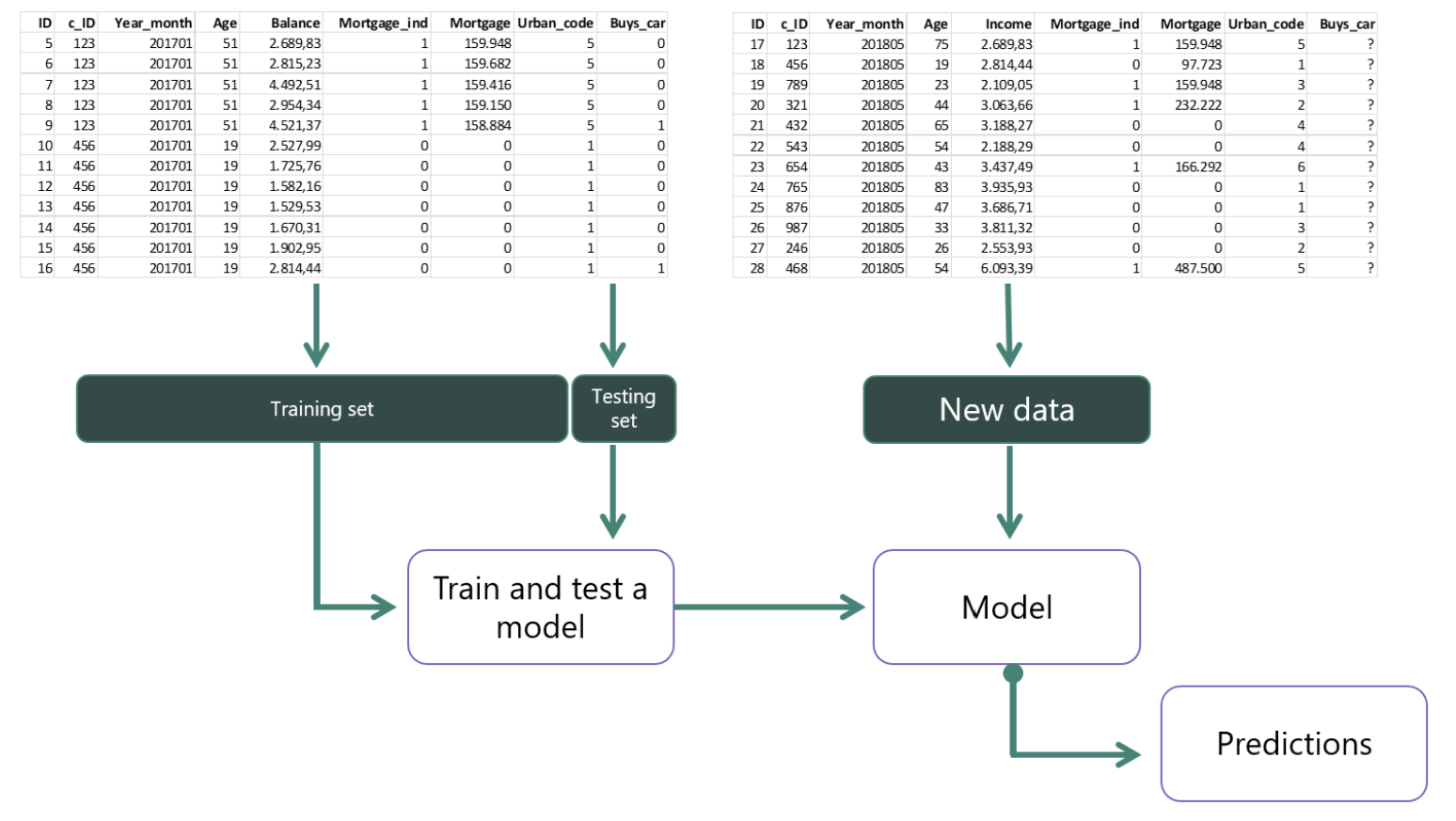
- Training set. Most of the sold houses. The model learns from these.
- Testing set. A slice of sold houses you hold back and pretend you know nothing about. You do know the real prices, which is exactly the point: the model predicts, and you check its answers against the truth it never saw.
- Iterate. If the model predicts 5 million for a house that sold for 4.5 million, you decide whether that is close enough. You go back and forth, improving until performance is acceptable. What counts as acceptable is a judgement call, and it belongs to you, not the algorithm.
- New data. Only then do you point the model at genuinely unseen data, like the house you are selling now, where nobody knows the answer yet. It returns a prediction, and you make a decision with it.
Types of question, types of model
The question you ask determines the kind of model you need:
- Classification answers a question with a limited set of categories. Will this house sell, yes or no? Is this email spam? The output is a class.
- Regression predicts a number on a continuous range. What price will this house sell for, anywhere from a few thousand to several million? Enumerating every possible value as a class would be absurd, so you predict the number itself.
The three families
Nearly every model falls into one of three categories.
Supervised
Task driven. You have historical data where the answers are known, and you learn from what already happened to predict what happens next. Both examples above are supervised. This is the most common and the most approachable family to start with.
Unsupervised
Pattern driven. You want to understand what is going on inside your data without knowing what you are looking for. The main example is clustering: the model groups entries that behave similarly, without being told what the groups mean.
The catch, and the interesting part, is that you may not understand why a cluster exists. "Expensive houses" is a grouping a human recognises. A model may find a pattern that is real, useful, and not obvious to the eye, and it will not explain itself.
Reinforcement
Environment driven. The model adjusts based on feedback, nudged toward good outcomes and away from bad ones. Training a dog is the intuitive version. Games are the classic technical one: nobody tells you the rules, you try moves, and progressing to the next level tells you that was right while dying tells you it was wrong. Over enough attempts you find your way to the goal without ever being given instructions.
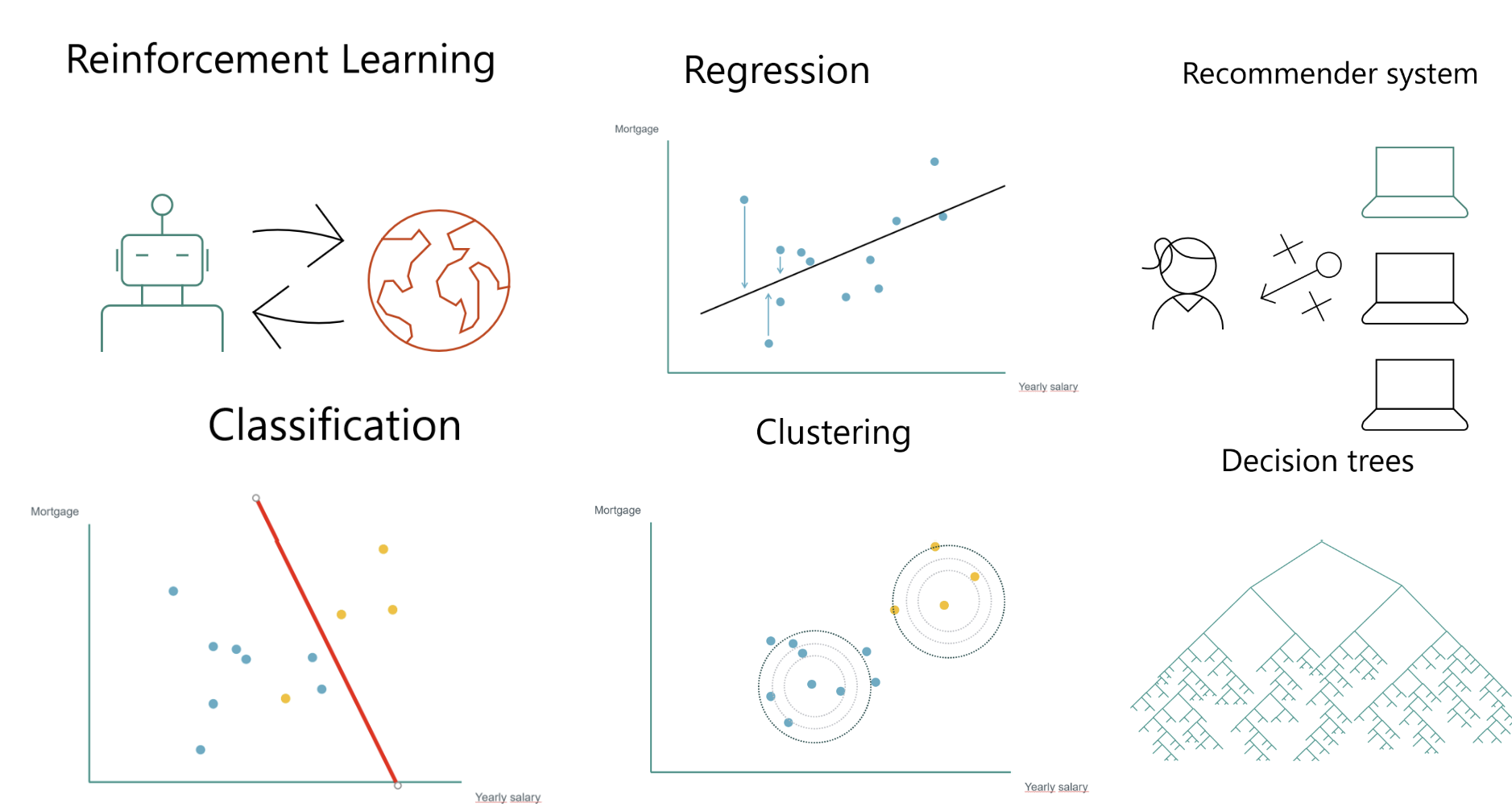
Underneath these families sit many specific models: decision trees, recommender systems (the Netflix and YouTube example), neural networks, and many more. You do not need all of them to start. You need to recognise which family your problem belongs to.
Why this matters for robotics
These three families map directly onto how robots learn. Supervised learning is behind the perception stack, a camera classifying what it sees. Imitation learning, where you teleoperate an arm and train a policy on your own demonstrations, is supervised learning with your recorded actions as the labels. Reinforcement learning is how policies get trained in simulation, where a robot can fail thousands of times cheaply before touching real hardware. The train/test discipline matters even more here, because a policy that performs perfectly on the positions it was trained on and fails on a new one is the robotics version of a model that memorised its training set.
Resources
- [Add your favourite intro to ML resources here via PR]
You can move on when you can...
- Train a classifier and evaluate it on a held-out test set
- Explain why you never tune on the test set